
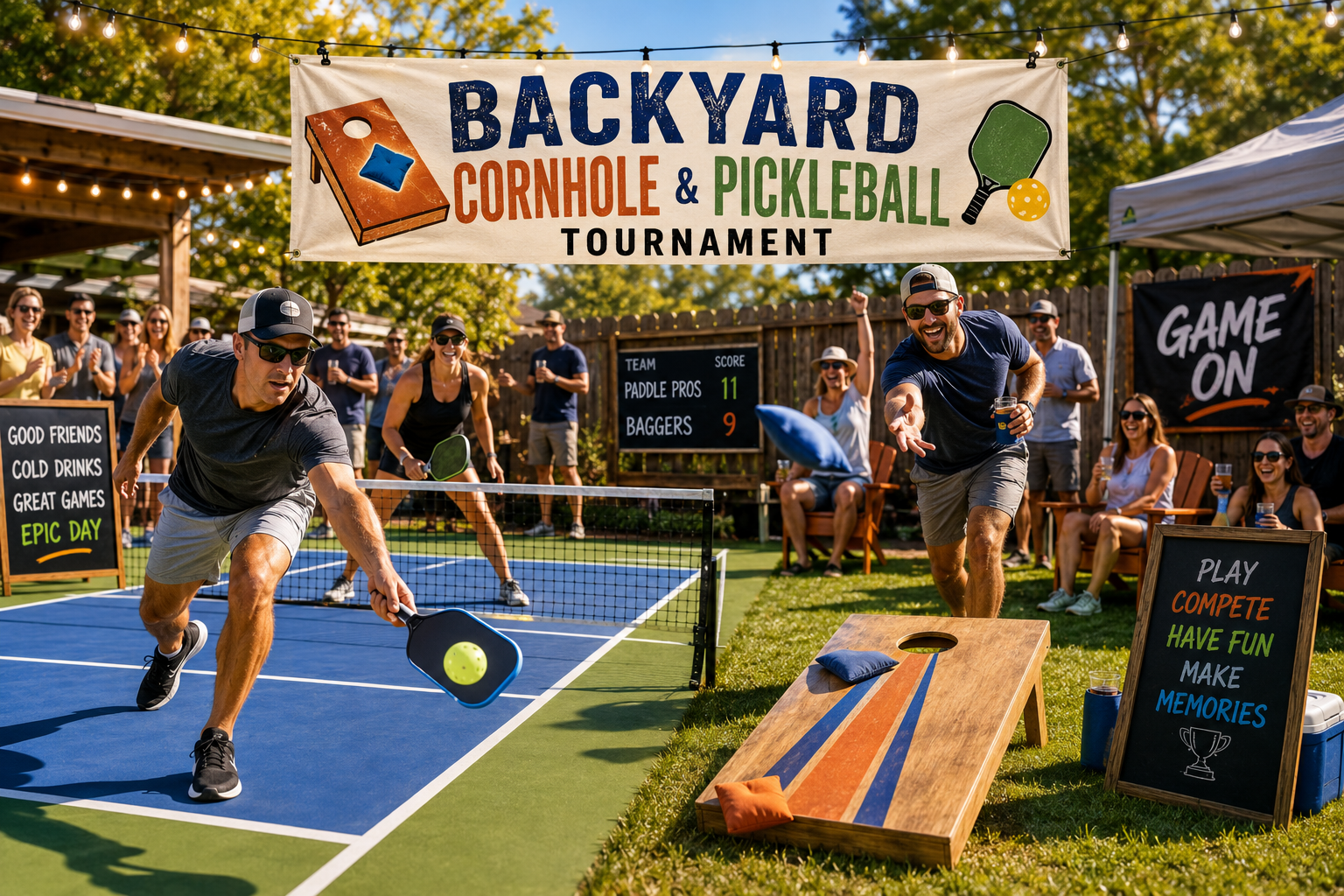
A backyard tournament can turn an ordinary Saturday into something people talk about for the rest of the summer.
You do not need a stadium, professional officials or a complicated rulebook.
You need two sports, a workable schedule, enough space, cold drinks, a few competitive people and at least one person willing to act like the championship trophy matters far more than it actually does.
Cornhole and pickleball make a strong backyard tournament combination because they work for different ages, fitness levels and personalities.
Pickleball brings movement, speed and actual athletic pressure.
Cornhole brings strategy, accuracy and the confidence of people who insist they are “normally much better than this.”
Together, they create a tournament that feels competitive without becoming too serious.
Here is how to build a Thunderfoot-style backyard cornhole and pickleball tournament from the first team announcement through the final championship round.
Start With the Right Tournament Format
The biggest mistake is creating a format that is too complicated.
People want to play.
They do not want to spend half the afternoon asking what round they are in.
For most backyard events, one of these formats works best.
Option 1: Team competition
Create two-person teams.
Each team plays:
- One pickleball match
- One cornhole match
- Additional matches based on standings or bracket advancement
Teams earn points for each win.
This is the easiest format for mixed-age groups because partners can balance each other.
Option 2: Individual championship
Each person competes individually but rotates partners during doubles play.
Players earn personal points based on:
- Pickleball results
- Cornhole results
- Bonus competitions
This creates a true overall champion but requires more scorekeeping.
Option 3: Family or neighborhood showdown
Group players by:
- Families
- Streets
- Friend groups
- Work teams
- Age groups
This format is less balanced, but it creates better rivalries.
The safest overall choice is a two-person team tournament.
It is simple, social and easy to track.
Decide How Many Teams You Can Handle
Do not invite twenty teams unless you have multiple courts, several cornhole lanes and a small event staff hiding somewhere.
For one pickleball court and two cornhole setups, a comfortable tournament usually includes:
- Four teams for a quick event
- Six teams for a solid afternoon
- Eight teams for a full tournament
- More than eight only with a detailed schedule
Six to eight teams create enough variety without causing long waits.
If children are participating, consider a separate youth division or pair younger players with adults.
That keeps the competition fun and prevents a ten-year-old from being forced to return a full-power serve from someone who has been secretly taking pickleball lessons for six months.
Build Balanced Teams
Random teams can be funny.
Balanced teams usually create a better tournament.
Try to spread out:
- Experienced pickleball players
- Strong cornhole players
- Younger athletes
- Older participants
- Highly competitive personalities
- People who are mainly attending for food
You can rank players loosely before assigning teams.
For example:
- Level 1: Experienced
- Level 2: Recreational
- Level 3: Beginner
Pair a Level 1 player with a Level 3 player or two Level 2 players together.
Another option is a live team draft.
Choose captains and let them select partners. This adds entertainment, but it also creates the possibility of someone being chosen last in front of the entire neighborhood.
Use carefully.
Choose the Best Backyard Layout
The tournament should feel organized without taking over the entire property.
Create four basic zones.
Pickleball zone
Use a driveway, sport court or flat paved area.
A regulation-size court is ideal, but many backyard games use a shortened recreational court. Mark boundaries clearly with court tape, chalk or temporary lines.
Make sure there is enough space behind the baseline and beside the court for safe movement.
Remove:
- Furniture
- Hoses
- Toys
- Extension cords
- Loose rocks
- Anything that becomes a lawsuit when someone chases a ball
Cornhole zone
Set up boards on level ground.
Traditional cornhole boards are placed 27 feet apart from front edge to front edge for adult play, though shorter spacing works well for children and casual groups.
Keep the throwing lane away from the pickleball court.
Nobody should be serving a pickleball while a beanbag flies through the same space.
Player waiting area
Set up:
- Shade
- Chairs
- Water
- Scoreboard
- Tournament schedule
- Towels
- Fans
Players need a place to recover between matches.
Food and spectator zone
Keep food, grills and coolers away from active play.
Spectators should be able to watch without sitting directly behind a pickleball baseline or beside the cornhole boards.
Create Simple Rules Before the Tournament
Rules should be explained before play begins.
Changing them midway through the tournament guarantees arguments.
Basic backyard pickleball rules
For a casual event:
- Play doubles.
- Use rally scoring or standard scoring.
- Set games to 11 or 15 points.
- Require a two-point winning margin only if time allows.
- Allow one short warmup.
- Use one serve attempt unless beginners are playing.
- Call obvious faults.
- Replay disputed points when no one is sure.
Rally scoring, where a point is awarded after every rally, keeps games moving faster.
Traditional pickleball scoring is more authentic, but it can confuse beginners and slow down the event.
For a backyard tournament, speed and fun usually matter more than strict formality.
Basic cornhole rules
- Each team uses four bags.
- Partners stand at opposite boards.
- Players alternate throws.
- A bag on the board scores one point.
- A bag through the hole scores three points.
- Use cancellation scoring.
- Play to 21.
- The first team to reach or exceed 21 wins.
Some casual groups require an exact score of 21.
Others allow teams to win by going over.
Decide before the first match.
The phrase “that is not how we played last time” should not become part of the championship round.
Use a Tournament Scoring System
A combined event needs a simple overall scoring structure.
One easy system is:
- Pickleball win: 3 points
- Cornhole win: 3 points
- Close loss: 1 bonus point
- Skills challenge win: 1 bonus point
A close loss might mean:
- Losing pickleball by three points or fewer
- Losing cornhole by five points or fewer
This keeps teams interested even after a loss.
Another option is total wins only.
That is easier, but ties become more common.
Sample Six-Team Tournament Schedule
For six teams, split everyone into two groups.
Group A
- Team 1
- Team 2
- Team 3
Group B
- Team 4
- Team 5
- Team 6
Each team plays the other two teams in its group in both sports.
That gives every team:
- Two pickleball matches
- Two cornhole matches
The top two teams from each group advance to the semifinals.
Semifinals
- Group A first place vs. Group B second place
- Group B first place vs. Group A second place
Championship
The semifinal winners play:
- One pickleball game
- One cornhole game
If the teams split the two sports, use a tiebreaker challenge.
Add a Thunderfoot Tiebreaker
A championship should not end with everyone staring at a spreadsheet.
Use a fast final challenge.
Good options include:
- One cornhole bag per player
- Pickleball target serve
- Longest pickleball rally
- Closest cornhole bag to the hole
- Combined relay
- Sudden-death cornhole
- First team to win three pickleball points
The best tiebreaker uses one skill from each sport.
For example:
- Each player throws one cornhole bag.
- Each player attempts one pickleball serve into a marked target.
- Highest combined score wins.
That keeps the final connected to both sports.
Create Tournament Divisions
If the age and skill range is wide, use divisions.
Competitive division
For experienced players and people who have brought their own paddles.
Recreational division
For casual adults and older teenagers.
Family division
For adult-and-child teams.
Youth division
For younger players using:
- Shorter cornhole distance
- Lower pickleball net if needed
- Smaller court
- Softer balls
- Shorter games
Divisions make the tournament more fair without removing the overall event atmosphere.
You can still bring everyone together for skills challenges and awards.
Add Skills Challenges Between Matches
Long waits kill tournament energy.
Use short side competitions while teams are waiting.
Cornhole skills
- Around-the-board challenge
- Longest made shot
- Four-bag accuracy round
- Opposite-hand throw
- Blind draw team round
Pickleball skills
- Serve accuracy
- Target volley
- Longest rally
- Dink challenge
- Paddle-control contest
Combined challenge
Set up a relay:
- Complete five pickleball volleys.
- Run to the cornhole lane.
- Make one bag on the board.
- Tag the next teammate.
This is exactly the kind of unnecessary competition that makes a backyard tournament better.
Plan for Texas Gulf Coast Heat
A summer tournament in Texas needs a heat plan.
Do not schedule the event for the hottest part of the afternoon if you can avoid it.
Better start times include:
- Morning
- Late afternoon
- Early evening
Provide:
- Shade
- Cold water
- Electrolyte drinks
- Cooling towels
- Fans
- Sunscreen
- Regular breaks
Shorten pickleball games when conditions are especially hot.
Cornhole can continue during lighter rest periods, but even cornhole players need water and shade.
Watch for:
- Dizziness
- Nausea
- Headache
- Weakness
- Confusion
- Poor coordination
Stop play when someone is struggling.
A backyard trophy is not worth a heat-related emergency.
Prepare for Wind
Gulf Coast wind can affect both sports.
For cornhole:
- Use stable boards.
- Place boards on level ground.
- Avoid lightweight bags in strong wind.
- Keep score sheets secured.
For pickleball:
- Expect the ball to drift.
- Reduce court size if conditions are difficult.
- Use wind screens where practical.
- Move play closer to protected areas.
Wind can make matches more challenging, but it can also make them fun.
Everyone has to play in the same conditions.
The person who complains the most is not automatically entitled to a rematch.
Add a Game-Day Atmosphere
A backyard sports tournament should feel like an event.
Add:
- Team names
- Matching colors
- Walk-up music
- Scoreboard
- Announcer
- Championship introductions
- Team photos
- Trophy presentation
- Music between games
Good team names can be based on:
- Local neighborhoods
- Gulf Coast themes
- Sports references
- Family names
- Inside jokes
Examples:
- Gulf Coast Grinders
- Dink Dynasty
- Bag to the Future
- The Kitchen Crew
- Board Members
- Paddle Battle
- Conroe Crushers
- Sandbaggers
- The Big Dills
- Thunderfoot Throwers
A cheap trophy becomes much more valuable once someone has spent six hours trying to win it.
Food That Works During a Tournament
Avoid serving the heaviest meal before pickleball starts.
Good early options include:
- Fruit
- Sandwiches
- Wraps
- Chips and salsa
- Vegetable trays
- Light snacks
Save heavier food for later:
- Burgers
- Hot dogs
- Barbecue
- Tacos
- Pizza
- Wings
Create a scheduled meal break rather than allowing everyone to disappear at random.
The tournament should pause for food.
Food should not pause the tournament every fifteen minutes.
Drinks and Alcohol
Provide plenty of water before offering beer or cocktails.
Use separate coolers for:
- Water and sports drinks
- Soft drinks
- Adult beverages
Players should limit alcohol during active competition, especially in hot weather.
Anyone driving should remain sober.
The same applies to anyone responsible for supervising children, operating a grill or settling disputed line calls with unnecessary confidence.
Make It Family-Friendly
A family tournament needs activities for people who are not currently playing.
Consider adding:
- Chalk area
- Water games
- Ring toss
- Mini cornhole boards
- Lawn games
- Coloring station
- Bubble machine
- Kids’ pickleball zone
Give younger children simple jobs:
- Score assistant
- Ball collector
- Team announcer
- Trophy helper
- Snack captain
That keeps them involved without requiring them to play every round.
Create a Simple Tournament Board
Use a poster board, whiteboard or printed bracket.
Display:
- Team names
- Match schedule
- Scores
- Standings
- Next games
- Championship bracket
Assign one person to update it.
Do not let every player write on the board.
By the third round, someone will have added an unofficial rule, changed a score or drawn something that does not belong on a family tournament display.
Tournament Roles
A smooth event needs a few assigned roles.
Tournament director
Keeps the schedule moving and settles disputes.
Scorekeeper
Tracks wins, points and standings.
Court manager
Calls the next pickleball teams and keeps equipment organized.
Cornhole manager
Resets bags and confirms scores.
Food coordinator
Manages meal timing and supplies.
Music and announcements
Handles playlists, introductions and championship energy.
One person can fill multiple roles for a smaller event.
The tournament director should not be the most competitive player unless you enjoy appeals, protests and accusations of corruption.
Awards That People Will Actually Enjoy
Not every award needs to be serious.
Give prizes for:
- Overall champion
- Pickleball champion
- Cornhole champion
- Best team name
- Best uniform
- Most improved
- Best sportsmanship
- Most dramatic loss
- Best excuse
- Loudest supporter
- First team eliminated
Prizes can include:
- Small trophy
- Medals
- Gift cards
- Sports towels
- Pickleball balls
- Cornhole bags
- Thunderfoot merchandise
- Championship beverage mug
A last-place trophy often becomes more memorable than the real trophy.
Backyard Tournament Equipment Checklist
Pickleball
- Net
- Paddles
- Balls
- Court tape or chalk
- Scoreboard
- Extra grip tape
- Towels
- Boundary markers
Cornhole
- Two or more board sets
- Bags
- Measuring tape
- Score towers
- Lights for evening play
Event setup
- Canopies
- Chairs
- Tables
- Fans
- Coolers
- Water
- Sunscreen
- First-aid kit
- Trash cans
- Extension cords
- Lighting
- Speaker
- Printed brackets
- Markers
Food
- Plates
- Cups
- Napkins
- Utensils
- Ice
- Serving supplies
- Trash bags
- Food covers
Sample Tournament Timeline
3:00 p.m.
Setup and player check-in
3:30 p.m.
Rules meeting and team photos
4:00 p.m.
Group-stage matches begin
5:30 p.m.
Meal break and skills competitions
6:15 p.m.
Final group matches
7:00 p.m.
Semifinals
7:45 p.m.
Championship round
8:30 p.m.
Awards and open play
Adjust the schedule based on heat, daylight and number of teams.
Evening lighting is important if the tournament may run late.
Have a Weather Backup Plan
Texas weather can change quickly.
Plan for:
- Heat
- Wind
- Rain
- Lightning
If lightning is nearby, stop play immediately and move inside.
For rain, possible alternatives include:
- Garage cornhole
- Indoor table games
- Sports trivia
- Bracket-style card tournament
- Rescheduled pickleball championship
Do not continue pickleball on a slick surface.
A competitive backyard event should create bragging rights, not orthopedic appointments.
The Thunderfoot Tournament Standard
A great backyard tournament does not have to look professional.
It does need to feel organized.
The best events have:
- Clear rules
- Balanced teams
- A visible schedule
- Enough shade
- Cold water
- Simple food
- Music
- A championship moment
- Plenty of reasons to laugh
Cornhole gives everyone a chance.
Pickleball gives the athletes room to compete.
Together, they create a backyard sports event that works for families, friends and neighbors.
Start small.
Use six or eight teams.
Keep the rules simple.
Add one ridiculous trophy.
Then let the competition do the rest.
Because once a championship bracket appears, nobody is “just playing for fun” anymore.