
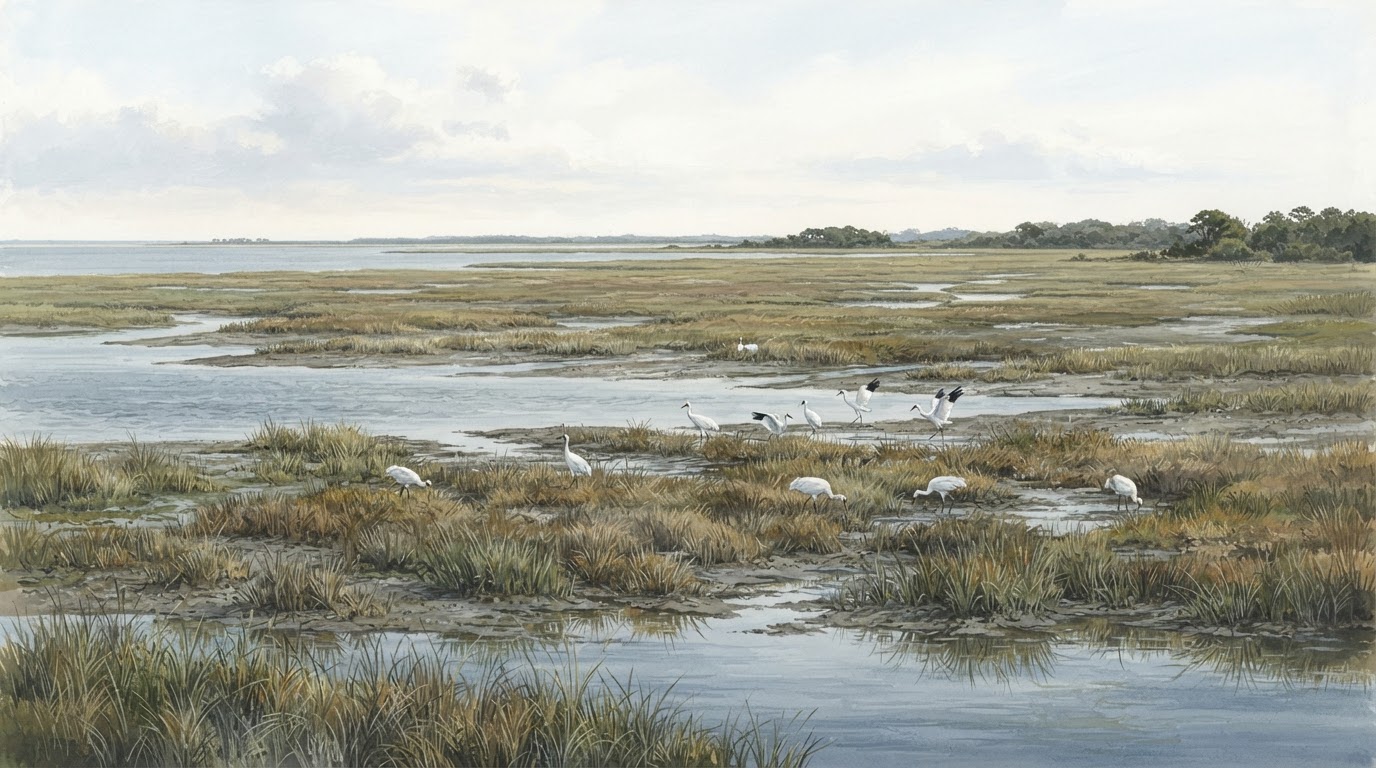
A morning at Aransas National Wildlife Refuge goes better if you give the marsh time. The U.S. Fish and Wildlife Service says winter is the best season to look for whooping cranes, which spend the season along the Texas coast. A view is never guaranteed. Bring binoculars and leave enough time to stop at more than one place.
Start where you can look a long way
The refuge points visitors to its marshes, observation towers, trails and auto tour route. Pick a stop with an open view and give it a few minutes. Scan the water’s edge slowly. It’s easy to sweep a wide stretch of marsh too fast and miss a bird that hasn’t moved.
Have a second thing you want to see
Give someone in the group the job of keeping a list of whatever you do see. A morning built around one bird can feel like a miss if that bird stays out of sight. The same morning starts to look different once someone spots movement in the reeds or notices how many other birds are using the water.
Build in time for the drive
Set a turnaround time if you have lunch plans or a long trip home. Check the refuge’s current visitor information before leaving so you have the right hours and know which facilities are open. Leave time for a slow stop on the auto tour. A good view is worth keeping the rest of the morning flexible.
Make sure you’re heading to the refuge entrance
Aransas National Wildlife Refuge is outside Austwell. The U.S. Fish and Wildlife Service gives separate driving directions for visitors approaching from the north and the south. Save the official visitor information before you leave, especially if you’re starting in an unfamiliar part of the coast. The last part of the drive takes you through a more rural area, and it helps when everybody riding with you has the same understanding of where the refuge entrance is.
Pick an arrival time based on the kind of visit you want. If you want to talk to someone at the visitor center and ask about current access, make sure it will be open. If your priority is to spend an early stretch looking out across the water, check the refuge grounds hours and what you need to do at the entrance. Those choices can put you on different schedules. A little planning at home gives you more time to look around once you get there.
The grounds and visitor center keep different hours
The refuge lists the grounds as open sunrise to sunset, seven days a week. Its winter visitor center schedule is 9 a.m. to 4 p.m., with closures on federal holidays. That means a day when you can enter the refuge may still be a day when nobody is at the desk. If you’re thinking of going Thanksgiving morning, plan on checking the posted information and following the after-hours registration instructions rather than depending on the visitor center being open.
The refuge lists a day fee of $3 for one adult in a vehicle or $5 for two or more adults, with various federal passes accepted. It takes cash or online payment. When the visitor center is closed, the agency directs visitors to the kiosk in front of the building to register or pay and pick up a map. Read how to use the pass you have before you make the drive, especially if somebody else in your party bought it.
A 16-mile drive can take as long as you let it
The refuge’s auto tour is listed at 16 miles. Give it more time than you’d give a 16-mile drive through town. You’ll want to stop where it’s permitted when the view looks promising. Some stretches of road may be interesting for the habitat alone. Other stops will be more about waiting for something to move. If the people in the car have different interests, agree to give each person a chance to pick a stop.
Try starting with one observation point and the auto tour as your main plan. If the first stop gives everybody a good view, stay for a while. If the sightlines are limited or the group is ready to move, use the map to find the next place you’d like to see. The whole outing doesn’t need to fit into one loop or one uninterrupted drive. A short trail or a quiet look from a platform can turn out to be the part the kids talk about afterward.
Give a distant bird time before you put a name on it
A white bird in the marsh is a reason to get the binoculars out. Look at the shape and compared size, and see what you can make out about the markings. If it flies, pay attention to how it carries itself in the air. A long view on a bright day can be surprisingly hard to read. It’s fine to leave a sighting unresolved if the distance or angle kept you from seeing what you needed to see.
Somebody will want to take a picture. Decide whether the camera or the binoculars helps most in that moment. A hazy photograph does little good if you spent the whole time looking at the back of the phone. A note about what the bird was doing and where you saw it can be more useful when you’re looking through a guide later. Stay on designated routes and give any animal the room it needs while you watch.
Pack for the time you’ll spend standing still
The clothes you’d wear to walk a trail continuously might feel different at an observation point. A layer that blocks the wind, a drink and a simple snack make it easier to spend a few extra minutes looking. Bring binoculars if you have them, and make them available to whoever has the hardest time seeing far across the water. If someone wants the group to travel light, share a pair rather than assuming everybody needs their own.
At the observation areas, make space for people who walked up while you were watching. A quick description of where to look can help the next person see what caught your eye. Photograph and observe from a distance, and give yourself room to move on if the animal is close to the route. The refuge has trails, shore views and habitat to look at even when the cranes are out of sight.
Leave with an idea for a second visit
Write down which stop you liked and what you’d spend more time on next time. Maybe the open view suited the group better than the drive, or a stretch of trail gave the kids more to notice. The refuge deserves a second visit even if the first one included a crane. The people who have the best time are often the ones who can change the plan after seeing what the marsh gives them that morning.
What to do if the group is split on how much to walk
The auto tour is a way to see a stretch of the refuge without committing everyone to a long walk. Still, the drive and a trail give you different views. The car is good for moving between habitats. A short stop on foot gives you time to hear what’s nearby and look from more than one angle. Start with an outing that works for the person who wants to cover the least distance. Anyone who wants additional walking can add a short stop after the group has seen the places it came for.
If getting up a tower or walking on an uneven surface would be a problem for somebody, check current access with the refuge ahead of time. Decide on a ground-level stop where everybody can look around together. That way sharing the morning does not depend on everybody having the same stamina or being comfortable with the same terrain.
Sources and planning links
U.S. Fish and Wildlife Service wildlife watching guide
Aransas National Wildlife Refuge visitor information
Aransas refuge hours, fees and directions