
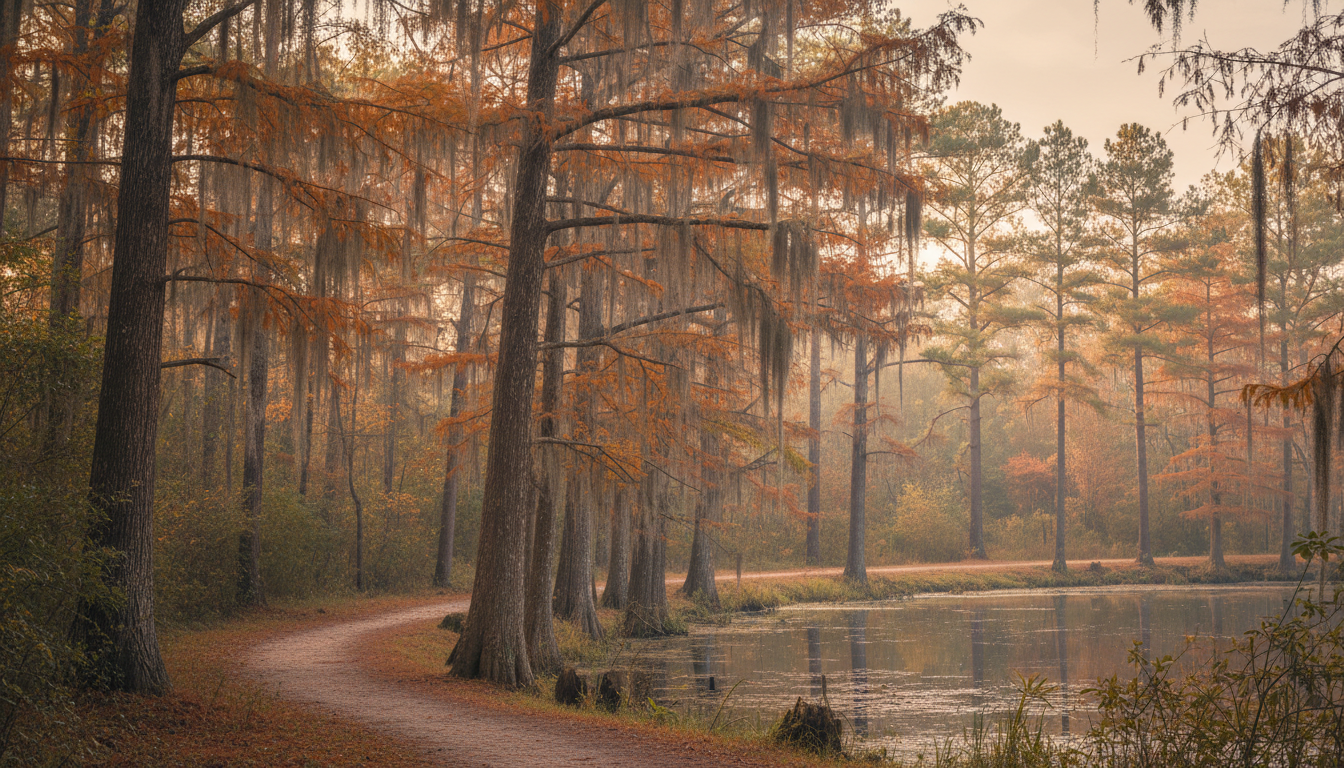
The most interesting thing about a fall afternoon at Caddo Lake is that the color does not announce itself the way a billboard does. A cypress may be dropping its needles above still water. A sweetgum might be turning just beyond a stand of pines. The ground under your shoes can change from dry, springy forest to damp leaf litter in a few steps. On Saturday, November 14, Caddo Lake State Park is inviting visitors to notice those differences with a ranger-led Fall Foliage Hike. It is the sort of outing that rewards slowing down instead of trying to cover the most miles possible.
Here is the confirmed Saturday plan
The Texas Parks and Wildlife event listing schedules the guided hike for Saturday, November 14, 2026, from 3:30 to 4:45 p.m. The meeting point is the park amphitheater across from Saw Mill Pond. The announced route is approximately one mile and includes the CCC Cut-Through and Caddo Forest Trail. That might sound short, but the park says participants should expect hills, steps and uneven ground. This is a nature program, not a paved walk around a neighborhood pond.
The program itself is free after the regular park admission, which the listing states as $4 for adults ages 13 and older, while children 12 and younger enter free. A Texas State Parks Pass may cover admission. Reservations for park entry are strongly recommended because the park can reach capacity. Call or check official updates for any change related to weather. Building the day around a reservation is far better than arriving after a long drive and discovering that there is no room.
Why Caddo feels so different from a typical Texas trail
Caddo Lake State Park sits beside Big Cypress Bayou, a landscape of water, bottomland woods and old bald cypress. The park’s nature guide describes upland, mesic and bottomland habitats across relatively short distances. That variety helps explain why a one-mile guided walk can feel like a miniature journey through several landscapes. Some trees hold leaves, others lose them, and some plants are shaped more by moisture than by the season printed on a calendar.
A ranger can help visitors notice the less obvious clues. Why does a bald cypress look almost prehistoric beside open water? What separates an oak from a sweetgum when you have only a fallen leaf in hand? Why might a forest floor be wet here and dry only a short walk uphill? These questions are more interesting than trying to guarantee a precise peak-color photograph. The real attraction is learning to read the place.
The colors are worth seeing, but not promising
Autumn color is an event that unfolds on its own schedule. Temperature, moisture, daylight and the particular trees all matter. The park’s program description says visitors will look for seasonal changes among the pines and learn why cypress lose their leaves. It does not promise that every tree will be bright orange on November 14. A good article should not promise that either. If you go expecting to notice small patches of color and a different quality of light, the outing has more ways to succeed.
Bring curiosity instead of an expectation copied from a dramatic photo taken during some other year. A rusty leaf beside a creek, filtered sunlight on moss, or a sudden view of water through trunks can be memorable without becoming a perfect fall postcard. This is especially true when young children are along. Ask each child to find three different leaf shapes instead of insisting that the trail produce one spectacular scene.
The route has history underfoot
The CCC in the trail name refers to the Civilian Conservation Corps, whose work shaped many Texas state park landscapes. Caddo’s official trail information describes historic park features, including the CCC recreation hall, and identifies the Caddo Forest Trail as a moderate route with steps. That is useful context for deciding whether the walk fits your group. It also adds an unexpectedly human layer: the forest is natural, but the visitor experience carries evidence of people who built a public place for generations to use.
Spend a moment looking at how a built path sits in the terrain. Stairs appear because the slope needs them. A trail curves around a feature worth preserving. The spaces where people gather for programs are connected to a longer history of public recreation. You do not have to turn the afternoon into a history lesson, but recognizing that relationship makes the walk feel richer than a simple loop.
What to pack for one mile of real woods
For a short hike, the important items are uncomplicated: water, shoes with dependable grip, clothes suited to the forecast, and something for sun and insects. The event description specifically recommends water, a hat, sunglasses, sunscreen and bug spray. A light layer can be helpful in November because a comfortable afternoon may feel different beneath the trees or after the sun drops. It is easy to underestimate the terrain because the advertised distance is small. Think of the one mile as an outdoor route with uneven surfaces, not a timed fitness test.
Keep your hands free when navigating steps and slopes. If you photograph a tree, pause somewhere safe instead of staring at a phone while walking downhill. A walking stick can help some visitors, but follow event guidance and be considerate on narrow sections. For families, the most practical preparation may be making sure everybody has used the restroom and filled a bottle before the guided group starts moving.
A child can enjoy this without knowing tree names
The ranger hike is a good opportunity to practice observation without turning the woods into an exam. Instead of asking a child to identify every species, try a few open-ended questions: Which leaf feels rough? Where does the ground become softer? Which tree seems to grow closest to water? Why do you think there are fewer small plants beneath this patch of shade? Children often notice details adults hurry past, especially when the goal is to describe rather than label.
Let them record a few observations in words or sketches after the walk. Picking up a fallen leaf where permitted can start a conversation, but do not remove plants, wildlife or natural materials if park rules prohibit it. The point is to leave the woods as you found them while going home with a better sense of what is there. That is a skill that makes future hikes anywhere in Texas more rewarding.
Photography without holding up the whole group
Caddo’s cypress and water are beautiful subjects, but a guided program works best when everyone can keep moving safely. If you want to take photographs, choose moments when the group has paused or let the guide know you may need to step aside. Avoid blocking stairs or narrow sections. Consider bringing one lens or using your phone rather than carrying an entire kit that changes how you walk. Low afternoon light can be lovely, but the forest may be much darker than the open road outside the park.
Photograph an actual detail instead of trying to reproduce someone else’s image exactly. Fallen needles floating near a cypress knee, a contrast between green pine and brown oak, or an old stone park structure can tell the story of the day. And be clear with people later: a photo taken in a previous season is not evidence of what visitors will see this Saturday.
Make the drive worthwhile without overfilling it
Caddo Lake State Park offers hiking, paddling, fishing, picnic spaces and historic cabins, but not every activity needs to fit into one visit. The official visit-planning page outlines half-day and longer options. If the ranger hike is the centerpiece, arrive with time to walk around the main visitor area, enjoy the quiet and get oriented. Trying to paddle, picnic, hike and drive on a tight schedule can turn a restful destination into a series of rushed transitions.
There is also value in saving a different activity for a return visit. A first afternoon can help you learn where the parking, trailheads and public spaces are. Next time, you might choose a longer walk or a different perspective on the water, subject to current conditions and any required arrangements. Places like Caddo usually become more interesting after you have stopped trying to see everything at once.
Wildlife deserves space
The park is habitat, not a wildlife display. Texas Parks and Wildlife describes birds, fish, mammals and alligators in the broader Caddo environment. There is no guarantee any particular animal will appear on a guided walk, and visitors should not approach or feed wildlife. If an animal is visible, stop at an appropriate distance and follow the ranger’s instructions. A small frog or a woodpecker call may be just as worth noticing as a much larger animal.
Stay on the trail even when an attractive photograph appears to be only a few steps away. Soft banks, wet ground and water can present hazards that are not obvious from a distance. Keep children close near the water, and do not treat an unfamiliar animal as something that needs to be touched to be appreciated. The best wildlife experience is one that does not change the animal’s behavior because you were there.
Before leaving home on Saturday
Check the park’s current alerts, reserve day-use entry if needed, confirm the 3:30 p.m. program and review any cancellation notice. The state park is at 245 Park Road 2 near Karnack, and the official page provides directions and contact information. The program itself says weather-related cancellations can be communicated by the park. Use those current details over an old social image or an outdated trip blog.
Thunderfoot’s Caddo Lake Fishing Map offers another way to explore the lake area, while the East Texas hub can point you toward more regional stories. On this particular Saturday, though, the best plan may be the simplest: arrive a little early, take the ranger’s one-mile route, watch the forest closely, and leave with a different understanding of fall in East Texas.