
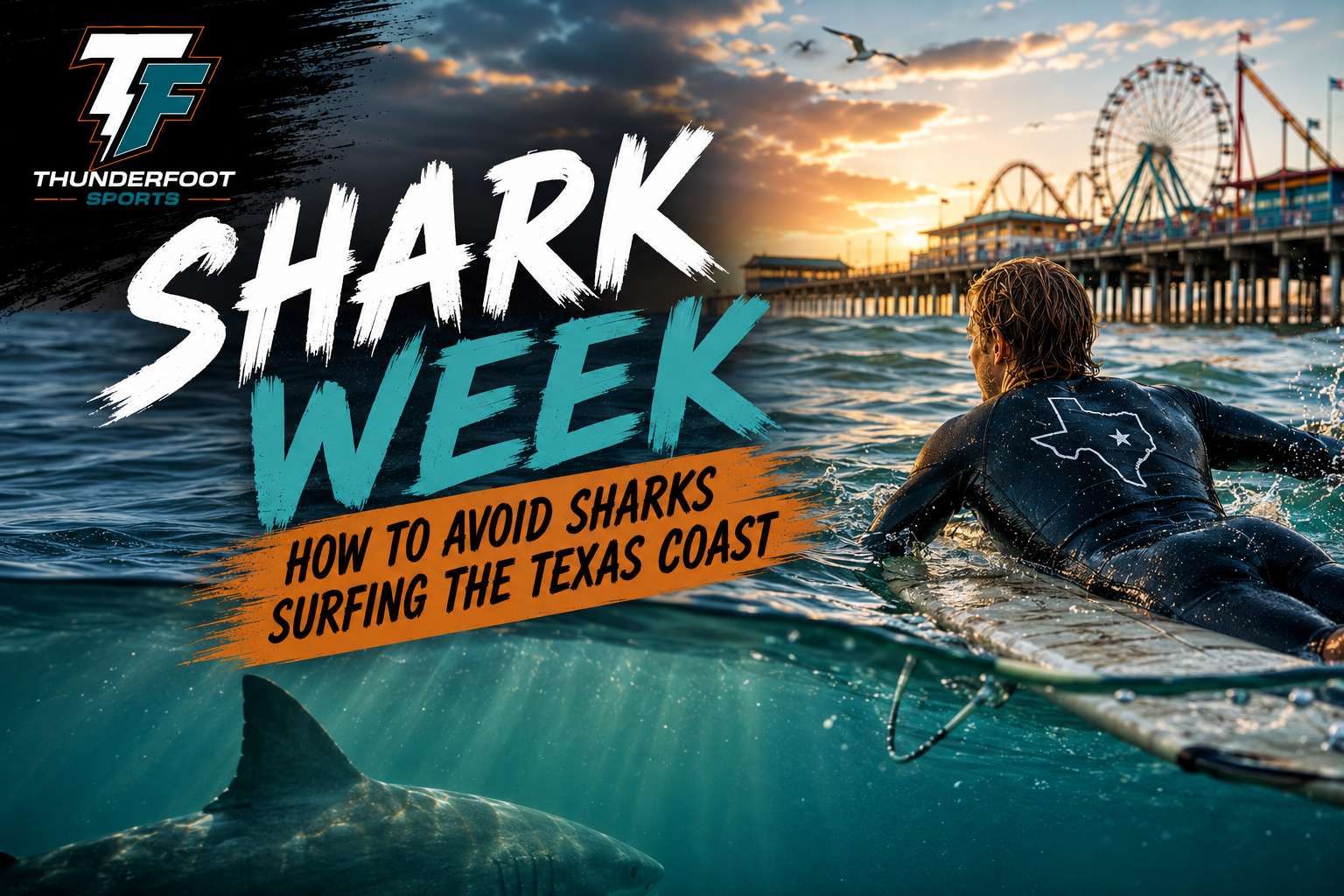
Shark Week is built around dramatic footage, ominous music and animals large enough to make an average surfboard look like an appetizer. The real Texas Gulf Coast is considerably less theatrical.
Sharks live along the Texas coast, and surfers enter their habitat every time they paddle beyond the break. That does not mean surfing in Galveston, Surfside, Matagorda, Port Aransas or South Padre Island is unusually dangerous. It means surfers should understand the conditions that can increase the chance of an encounter—and know when skipping a session is the smarter call.
No strategy can guarantee a shark-free surf session. You can, however, reduce your risk by choosing the right time and location, watching for feeding activity and responding calmly when something feels wrong.

Put the Risk in Perspective
The International Shark Attack File confirmed 65 unprovoked shark bites worldwide in 2025. Twenty-five occurred in the United States, and only one was recorded in Texas. Surfers and other board-sport participants accounted for 32 percent of documented incidents, but researchers continue to describe the overall risk of being bitten as extremely low. (Florida Museum)
Sharks do not normally hunt people as prey. NOAA explains that most sharks pose little danger to humans and generally prefer fish and marine mammals. When bites occur, they may involve mistaken identity, investigation, competition around food or a defensive response. (National Ocean Service)
Texas waters are still genuine shark habitat. Bull sharks are common off the Texas coast and can tolerate salt, brackish and freshwater. Blacktip sharks are also common throughout the Gulf of Mexico. Their presence is normal and important to the marine ecosystem—not evidence that a beach has suddenly become unsafe. (Texas Parks & Wildlife)
Surf During Full Daylight
Dawn patrol may deliver cleaner waves and fewer people, but it also places surfers in the water during low-light conditions. Shark-safety guidance consistently recommends avoiding dawn, dusk and nighttime because visibility is reduced and many sharks are actively feeding during those periods. (Florida Museum)
For a lower-risk Texas surf session, wait until the sun is fully up. Finish before evening light begins fading.
This does not mean every sunrise session is dangerous. It means daylight removes one avoidable risk factor while also making it easier to see baitfish, fins, birds, floating debris and other surfers.
Never Paddle Out Alone
A quiet peak can be tempting, but complete isolation is not worth it.
Surf with at least one other person and stay within a reasonable distance of the group. A buddy can spot activity you miss, help you return to shore and immediately call for assistance during an emergency. Shark-safety organizations also recommend staying relatively close to shore rather than becoming isolated far outside the main break. (Florida Museum)
Surfers naturally need to paddle far enough out to reach breaking waves. The practical goal is not to hug the beach—it is to avoid surfing remote water where no one can see or quickly reach you.
Learn to Recognize a Bait Ball
One of the biggest warning signs is concentrated feeding activity.
Large schools of baitfish may appear as dark, rapidly moving patches under the surface. Fish may begin jumping, the water may boil with activity or birds may repeatedly dive into the same area. Those signs indicate predators are feeding nearby, and the predators may include sharks.
Texas Parks and Wildlife specifically advises leaving the water when large schools of bait gather near shore because a predator may be nearby. During the July 2024 South Padre Island shark encounters, officials repeated that advice and told beachgoers to exit calmly when sharks or heavy bait activity are observed. (Texas Parks & Wildlife)
Do not paddle closer because the wildlife looks interesting. Give the activity plenty of room and wait for it to pass.
Stay Away from Active Fishing Areas
Surfers and anglers can coexist along the Texas coast, but they should not occupy the same patch of water.
Avoid paddling near people casting bait, using fish stringers, fighting hooked fish or cleaning their catch. Stay clear of active fishing piers, heavily fished jetties and areas where bait or fish remains are entering the water. The International Shark Attack File recommends avoiding recreational and commercial fishing areas, particularly when baitfish or feeding activity is visible. (Florida Museum)
A pier may produce a decent wave, but the combination of hooks, bait and struggling fish makes the lineup less attractive from a safety standpoint.
Give anglers enough distance that you are not swimming through their fishing zone—and enough distance that a hooked shark cannot reach you.
Think Twice About Murky Water
The Texas surf is not always postcard-clear. When visibility becomes especially poor, both the surfer and the shark have less information about what is moving through the water.
Shark-safety guidance recommends using additional caution in murky or low-visibility conditions. Researchers note that some sharks may have just as much difficulty seeing as the person in the water, increasing the possibility of a close investigative encounter or mistaken identification. (Florida Museum)
Poor visibility alone does not mean sharks are present. Combine it with other warning signs, however—baitfish, diving birds, active fishing or an isolated lineup—and the decision becomes easier.
There will always be another session. Your board does not need you to prove anything to it.
Do Not Surf With an Open, Bleeding Wound
Scientific guidance does not support every movie-inspired claim about sharks detecting a tiny drop of human blood from miles away. Still, experts recommend staying out of the water when you have an actively bleeding wound. Blood, food, struggling fish and other unusual sensory cues can increase animal interest or feeding behavior. (Florida Museum)
Covering a fresh cut with a weak adhesive bandage and hoping the Gulf handles the rest is not a safety plan.
Wait until the bleeding has stopped and the wound can be properly protected. That also reduces exposure to bacteria naturally found in coastal water.
Reduce Unnecessary Splashing
Surfing inevitably involves paddling, kicking and wiping out. Nobody expects you to move across the lineup like a museum display.
What you can avoid is prolonged, frantic splashing in one location. Low-frequency sounds produced by distressed or struggling movement may attract a shark’s curiosity. Experts therefore recommend controlled movement rather than panicked thrashing. (Florida Museum)
The same principle applies when returning to shore after a sighting: move steadily and deliberately. Do not turn the situation into an aquatic fire drill.
Shiny jewelry should also remain on land because reflected light may resemble flashing fish scales. High-contrast gear may be more visible underwater, although visibility to human rescuers is also important. There is no need to replace every bright rash guard, but leaving watches, chains and reflective jewelry in the vehicle is easy. (Florida Museum)
Dolphins Do Not Mean the Water Is Shark-Free
Seeing dolphins near the lineup is one of the best parts of surfing the Gulf Coast. It is not an all-clear signal.
Dolphins and sharks may feed on the same fish and occupy the same area. The presence of dolphins does not prove that sharks are absent. (Florida Museum)
Enjoy the sighting, but continue watching the water and evaluating the conditions around you.
Listen to Lifeguards and Local Warnings
Before paddling out, look for posted beach warnings, closures and instructions from lifeguards or beach patrol. If officials clear the water because of a sighting, do not argue that the waves finally cleaned up or that you drove two hours to get there.
Leave immediately and remain out until officials indicate that conditions are safe.
Texas Parks and Wildlife describes serious shark encounters as uncommon, but its advice is straightforward: when a shark is seen, calmly exit and allow the animal to pass. (Texas Parks & Wildlife)
What to Do When You See a Shark
A fin in the water does not automatically mean an attack is beginning. It does mean your session is over for the moment.
Maintain visual contact with the shark and begin moving toward shore without frantic splashing. Signal nearby surfers so the group can leave together. Do not chase, touch, photograph or attempt to identify the animal from closer range.
The International Shark Attack File recommends maintaining eye contact, slowly moving away and exiting the water when possible. If the shark continues approaching, stay oriented toward it rather than turning your back and paddling blindly. (Florida Museum)
Keep your board with you. It provides flotation, helps you reach shore and may create separation between you and the animal.
What to Do if a Shark Makes Contact
Fight back.
Target the shark’s eyes and gills, which are sensitive areas. Strike or push the snout when necessary, using your hands, feet or available equipment. Do not remain passive and hope the animal loses interest. (Florida Museum)
Once the shark backs away, move toward shore quickly but with controlled movements. Continue watching the animal and stay close to other surfers.
After reaching land, call 911 immediately. Severe bleeding requires firm, continuous direct pressure over the wound. A commercial tourniquet may be needed for life-threatening bleeding from an arm or leg, particularly when direct pressure is not controlling it; proper Stop the Bleed or first-aid training is strongly recommended. (American Red Cross)
The Texas Surfer’s Shark-Safety Checklist
Before paddling out, ask four questions:
- Is it fully daylight, with reasonable visibility?
- Are other surfers or lifeguards present?
- Are baitfish, diving birds or active anglers nearby?
- Are any warnings, sightings or beach closures posted?
One concerning answer may not automatically cancel the session. Several concerning answers together should.
Respect the Water, Not the Movie Monster
Shark Week works because sharks are powerful, mysterious and incredibly good television. In real life, they are also essential predators that help maintain healthy marine ecosystems. Texas Parks and Wildlife’s 2026 Shark Celebration emphasized science, conservation and appreciation rather than fear. (Texas Parks & Wildlife)
The goal is not to pretend sharks are harmless. It is to understand that fear and carelessness are equally unhelpful.
Surf in daylight. Stay with other people. Avoid feeding activity and fishing areas. Take murky conditions seriously. Leave calmly when a shark is seen.
Then get back to enjoying the Texas coast—because the best Shark Week story is still the one where you caught a few waves, respected the wildlife and came home with every part exactly where it started.