
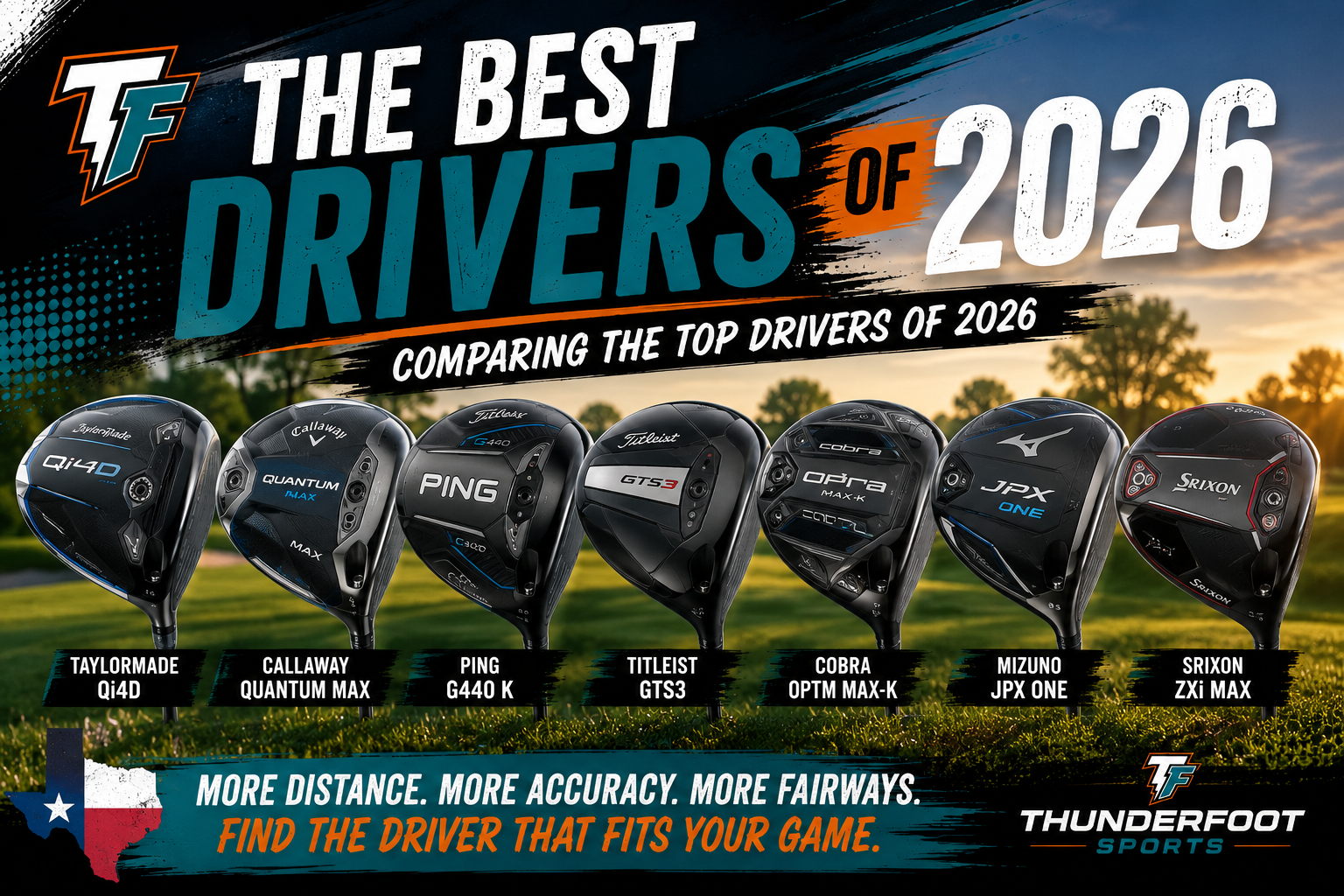
Buying a new driver in 2026 is less about finding the club with the loudest marketing campaign and more about matching the head, loft, shaft and weight configuration to the way you actually swing.
This year’s leading drivers emphasize slightly different priorities. TaylorMade is chasing balanced speed and consistency. Callaway is delivering serious distance. PING and Cobra are pushing stability. Titleist is targeting precise ball-flight control, while Mizuno is introducing a completely new face material.
After comparing current designs, manufacturer specifications and independent testing, the TaylorMade Qi4D earns our best-overall pick, but it is not automatically the right driver for every golfer. The Callaway Quantum Max may be longer for some players, the Srixon ZXi Max may be more forgiving, and the PING G440 K may do a better job keeping ugly swings in play.

The Quick Picks
Best overall: TaylorMade Qi4D
Best for distance: Callaway Quantum Max
Best for forgiveness: Srixon ZXi Max
Best premium stability: PING G440 K
Best for better players: Titleist GTS3
Best adjustability: Cobra OPTM MAX-K
Most innovative: Mizuno JPX ONE
Best for fighting a slice: Callaway Quantum Max D
TaylorMade Qi4D Driver
Best overall
$649.99
Callaway Quantum Max Driver
Best distance
$649.99
PING G440 K Driver
Premium stability
$649.00
Titleist GTS3 Driver
Better-player control
$699.99
Cobra OPTM MAX-K Driver
Maximum adjustability
$599.00
Mizuno JPX ONE Driver
Newest face technology
$599.99
Srixon ZXi MAX Driver
Best forgiveness value
$399.99
Callaway Quantum Max D Driver
Best slice help
$649.99
TaylorMade Qi4D: Best Driver Overall
The standard TaylorMade Qi4D offers the strongest combination of distance, accuracy, forgiveness and adjustability in the 2026 field.
MyGolfSpy named it the top overall driver after it ranked sixth for distance, fourth for accuracy and fourth for forgiveness in its testing. Rather than winning one category and struggling elsewhere, the Qi4D produced consistently strong results across all three. (MyGolfSpy)
TaylorMade redesigned the head for better aerodynamics, refined the face’s roll radius to preserve speed on high and low strikes, and added four movable Trajectory Adjustment System weights. Its 60-layer carbon face also uses corrective curvature intended to tighten dispersion on heel and toe contact. (TaylorMade Golf)
That combination makes the standard Qi4D especially appealing to the everyday golfer who does not need an extreme low-spin or maximum-draw model. It has enough adjustability for a fitter to influence launch, spin and shot shape without forcing the golfer into an oversized game-improvement head.
Best for: Low-to-mid handicappers who want balanced performance.
Possible drawback: Golfers needing maximum forgiveness may perform better with the Qi4D Max, Qi4D Max Lite or another high-MOI model.
Callaway Quantum Max: Best for Distance
Golfers who want every available yard should put the Callaway Quantum Max near the top of their fitting list.
In MyGolfSpy’s overall test, the Quantum Max finished second and earned the highest distance score. It also ranked second for accuracy, although its shot-to-shot forgiveness was closer to the middle of the pack. (MyGolfSpy)
Callaway’s major 2026 change is its Tri-Force Face, which integrates titanium, carbon fiber and a material Callaway calls Poly Mesh. The face is paired with next-generation artificial-intelligence mapping designed to control speed, launch and spin across a wider impact area. (Callaway Golf)
The result is a driver that can produce excellent carry and total distance without requiring a small, intimidating tour-style head. It has a confidence-inspiring profile and enough adjustability to fit a broad range of swings.
However, the Quantum Max illustrates why “longest” and “best” are not always identical. Its independent test results showed more variation in ball speed, carry distance and dispersion than the most forgiving options. (MyGolfSpy)
Best for: Golfers who strike the ball reasonably well and want additional distance.
Possible drawback: Players with inconsistent face contact may benefit more from a higher-forgiveness model.
Srixon ZXi Max: Best for Forgiveness and Value
The Srixon ZXi Max is not the flashiest driver in this comparison, but it may be the smartest purchase.
MyGolfSpy rated it the most forgiving driver for 2026 based on consistency in ball-speed variation, carry-distance variation and overall dispersion. Its forgiveness score led the test, although it did not match the longest models for outright distance. (MyGolfSpy)
Srixon describes the ZXi Max as the highest-MOI driver in its lineup. It uses an i-FLEX face-thickness pattern to improve energy transfer and a lightweight Star Frame Crown that allows mass to be positioned lower and farther back. A rear sole weight can also be changed to influence swing weight. (Dunlop Sports)
Because the ZXi Max is now available below its original price at some retailers, it creates a compelling value argument against newer drivers priced around $600 to $700.
Best for: Mid-to-high handicappers who value predictable results over maximum distance.
Possible drawback: The higher-launching, higher-spin profile may not suit golfers who already produce too much spin.
PING G440 K: Best Premium Stability
PING built the G440 K for golfers who want the clubhead to resist twisting when impact moves away from the center.
The company calls it the straightest and most forgiving adjustable driver it has produced. A 32-gram movable back weight allows the center of gravity to shift among draw, neutral and fade positions, while carbon construction saves mass that can be placed lower and deeper in the head. (PING)
In Golf Monthly’s launch-monitor comparison, the G440 K produced strong ball speed, excellent stability and reliable performance across the face. Its adjustable rear weight also helped support different strike and shot-shape patterns. (Golf Monthly)
The G440 K did not beat the Srixon in MyGolfSpy’s broader definition of forgiveness, which is a useful reminder that MOI alone does not guarantee the most consistent results for every golfer. Still, it was identified alongside Cobra’s OPTM MAX-K as one of the stronger high-MOI choices available. (MyGolfSpy)
Best for: Golfers who miss across the face and want premium stability with directional adjustment.
Possible drawback: The larger shape, turbulators and heavier feel will not appeal to everyone.
Titleist GTS3: Best for Control and Better Players
The Titleist GTS3 arrived later in the 2026 season than most of the drivers in this comparison, so it was not part of every early-year independent test. Even so, it quickly established itself as one of the most intriguing options for skilled players.
Titleist positions the GTS3 as the model for golfers who want control over speed, ball flight and direction. Compared with the more forgiving GTS2, the GTS3 has a more compact profile, deeper face and lower-launching, lower-spinning design. Its new Speed Sync Face and dual-weight system give fitters more control over launch, spin and the golfer’s ability to square the face. (Titleist)
In a head-to-head Golf Monthly test, the GTS3 launched slightly higher and spun roughly 200 revolutions per minute less than the PING G440 K for that tester. It also retained ball speed and controlled dispersion well on mishits, even though the impact feedback made those mishits easier to feel. (Golf Monthly)
Best for: Confident ball-strikers who want speed, feedback and precise fitting options.
Possible drawback: It may provide more feedback—and less visual reassurance—than higher-handicap golfers want.
Cobra OPTM MAX-K: Best for Adjustability
Cobra has quietly created one of the most technologically interesting drivers of 2026.
The OPTM MAX-K is Cobra’s highest-MOI driver and is marketed around a combined three-axis MOI figure of 13,000. The goal is to preserve stability and ball speed when contact occurs away from the center of the face. (COBRA Golf)
Its biggest advantage is Cobra’s FutureFit33 hosel. Golfers and fitters can select from 33 loft-and-lie combinations, adjusting each by as much as two degrees in different directions. That provides far more flexibility than a simple loft sleeve with only a handful of settings. (COBRA Golf)
Independent testing placed the OPTM MAX-K among the better high-MOI options, although it did not dominate the overall rankings. (MyGolfSpy)
Best for: Golfers who want maximum fitting flexibility and a stable head.
Possible drawback: Its stability claims should not replace an actual fitting; high MOI does not automatically mean tight dispersion for every swing.
Mizuno JPX ONE: Most Innovative Driver
The Mizuno JPX ONE is the wild card of the group.
Released during the summer of 2026, it uses what Mizuno describes as the first Nanoalloy driver face. The material contains microscopic polymer dispersion designed to change elasticity during impact and preserve speed across more of the face. (Mizuno Golf Official Website)
The standard JPX ONE has a lower and deeper center of gravity, an 11-gram rear weight, a straighter-flight design and a higher-MOI profile. Mizuno also offers the JPX ONE Select for golfers who prefer a more compact, player-oriented shape. (Mizuno Golf Official Website)
The technology is fascinating, but because the model reached the market later than many competitors, it has a smaller body of long-term independent testing. That makes it a driver to test rather than blindly purchase based on the face story alone.
Best for: Golfers intrigued by new materials who still want a forgiving, straight-flight head.
Possible drawback: Less extensive independent testing than the established early-2026 releases.
Callaway Quantum Max D: Best for Fighting a Slice
For golfers who regularly lose drives to the right, the Quantum Max D may be more useful than the standard Quantum Max.
Callaway designed the Max D to launch higher, provide maximum forgiveness and create a mild draw bias. It uses the same Tri-Force Face and AI-assisted face mapping found in the broader Quantum family. (Callaway Golf)
A draw-biased driver will not repair a severely open clubface or an extreme out-to-in swing. It can, however, make it easier to square the face and reduce the severity of a playable fade or moderate slice.
Best for: Moderate slicers and golfers who need easier launch.
Possible drawback: Players who already draw or hook the ball should look elsewhere.
Which 2026 Driver Should You Buy?
For the broadest range of golfers, the TaylorMade Qi4D is our overall winner. It combines speed, accuracy, forgiveness and fitting flexibility better than any single competitor.
The Callaway Quantum Max is the distance choice. The Srixon ZXi Max provides the strongest forgiveness-and-value combination, while the PING G440 K offers premium stability and adjustable weighting.
Better players should compare the Titleist GTS3, standard Qi4D and Callaway Quantum Triple Diamond models. Golfers who need slice correction should begin with the Quantum Max D, while players who enjoy detailed fitting should test the Cobra OPTM MAX-K.
Most importantly, do not select loft based solely on the number stamped on your current driver. A senior Callaway fitter recently identified incorrect loft as one of the most common equipment mistakes, noting that dynamic loft and attack angle should be considered during a fitting. (Golf Monthly)
The best driver of 2026 is not necessarily the one that produces your single longest shot in a simulator. It is the one that repeatedly gives you playable distance when your swing is less than perfect—which, inconveniently, is most of the time.