
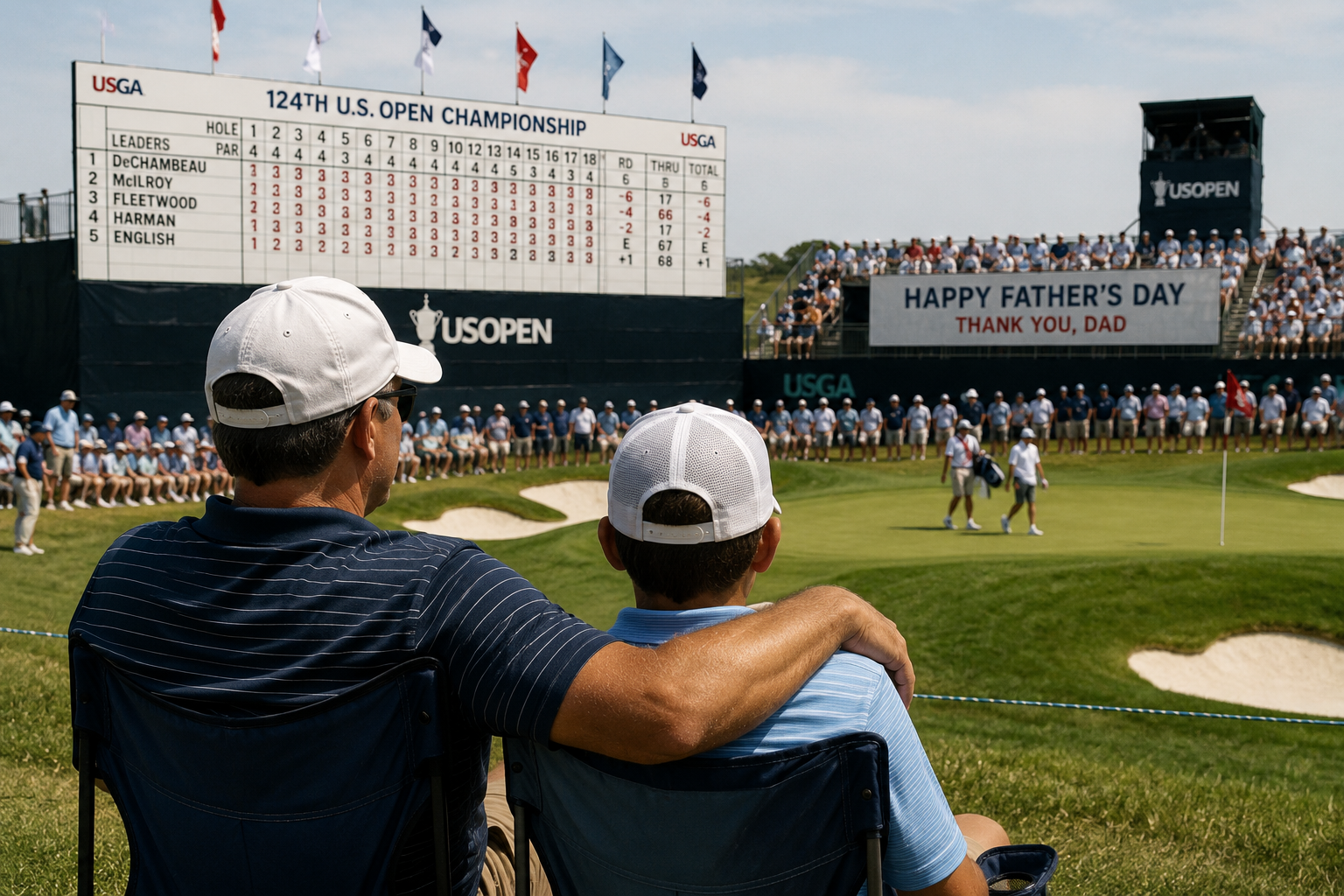
Every sport has its calendar moments.
Football owns Thanksgiving. Baseball feels like summer. The Masters gets spring. And for a lot of golf fans, Father’s Day belongs to the U.S. Open.
It is a strange pairing when you think about it. Father’s Day is supposed to be relaxing. The U.S. Open is the golf tournament most likely to make the best players in the world look like they are trying to assemble patio furniture without instructions. Fairways get narrow. Rough gets thick. Greens get fast. Pars feel like small miracles. Birdies feel like found money.
And yet, somehow, it works.
For decades, the U.S. Open has settled into one of golf’s most familiar traditions: a major championship finishing on Father’s Day weekend. For dads who love the game, it is a perfect setup. Play early if you can, grill something afterward, then sit down and watch the best players in the world suffer through the same basic emotions weekend golfers know very well.
Confusion. Hope. Regret. Brief confidence. More regret.
That is the beauty of the U.S. Open.
A Tournament Built to Test Everybody
The U.S. Open dates back to 1895, when the first championship was played at Newport Golf Club in Rhode Island. It was not the massive national event we know today. It was a 36-hole competition played in one day, with a tiny field compared to modern majors.
The winner was Horace Rawlins, a young English professional who took home the first title and helped start what would become one of golf’s defining championships.
Over time, the U.S. Open grew into something bigger than a tournament. It became golf’s public examination. The Masters has beauty. The Open Championship has weather and history. The PGA Championship has depth. But the U.S. Open has a very specific identity: it asks players how much discomfort they can handle without losing their minds.
That is not a criticism. That is the brand.
The U.S. Open is supposed to be hard. It is supposed to reward patience, accuracy, discipline, and the ability to make bogey without acting like the world has ended. That is also why regular golfers can relate to it. Most of us are not hitting 185-yard approach shots to tucked pins, but we do understand the feeling of standing over a five-footer and suddenly forgetting how arms work.
Why Father’s Day and the U.S. Open Fit So Well
The U.S. Open traditionally ends on Father’s Day, and that timing has turned the final round into a golf-watching ritual for a lot of families.
For some dads, it is the one Sunday where the remote control feels like part of the gift. The tournament is on, the grill is nearby, and everyone understands that Dad may be emotionally unavailable for a few hours if the back nine gets interesting.
There is also something fitting about the way the tournament lines up with the holiday. Golf is a game often passed down. A lot of people first learn the sport from a father, grandfather, stepdad, uncle, or someone who filled that role. Maybe it started at a driving range. Maybe it was a cheap municipal course. Maybe it was riding in the cart and being told not to talk during the backswing, which immediately made talking during the backswing seem very appealing.
Golf has a way of becoming a family language. It gives people something to do together even when they are different ages, different skill levels, or in completely different stages of life. You can be a dad trying to break 90, a kid just learning to make contact, or an adult son who now realizes your father’s “easy swing” advice was more useful than you wanted to admit.
That is why the U.S. Open on Father’s Day works. The tournament is demanding, but the day around it is personal.
Payne Stewart, Phil Mickelson, and the Fatherhood Moment at Pinehurst
One of the most memorable Father’s Day connections in U.S. Open history came in 1999 at Pinehurst No. 2.
Payne Stewart won that championship in unforgettable fashion, rolling in a clutch putt on the 72nd hole to beat Phil Mickelson by one shot. The image of Stewart’s fist pump remains one of the iconic moments in U.S. Open history.
But the moment had another layer.
Mickelson was not just trying to win his first major. He was also waiting on the birth of his first child. His wife, Amy, was due soon, and Mickelson had reportedly carried a beeper during the final round in case she went into labor.
That made the Stewart-Mickelson finish about more than golf. Stewart won the tournament, but afterward he acknowledged the bigger moment waiting for Mickelson: becoming a father.
It remains one of the great U.S. Open scenes because it showed both sides of the sport. On one side, a brutal championship decided by one stroke. On the other, a reminder that even major championships are still part of real life.
Golf has a way of humbling everyone. Fatherhood does too.
Justin Rose and the Point to the Sky
In 2013, Justin Rose won the U.S. Open at Merion and delivered one of the tournament’s most emotional Father’s Day moments.
After finishing the job, Rose pointed to the sky in memory of his late father, Ken, who had played a major role in his golf life. It was not loud or dramatic. It was simple, personal, and instantly understood by anyone who has ever connected a sport, a parent, and a lifetime of memories.
That is the thing about Father’s Day sports moments. They do not need much explanation.
A trophy is one thing. Winning it while thinking about the person who helped you get there is something else entirely.
Tiger Woods, Fatherhood, and the 2008 U.S. Open
Tiger Woods’ 2008 U.S. Open win at Torrey Pines is remembered for a lot of reasons: the injured leg, the dramatic putt on the 72nd hole, the Monday playoff with Rocco Mediate, and the sheer absurdity of Tiger winning a major while clearly not physically right.
But it also came during a new chapter of his life. Woods’ daughter, Sam, had been born the year before, and by the time he won at Torrey Pines, he was not just Tiger the dominant golfer. He was also Tiger the dad.
That added a different texture to the moment. The 2008 U.S. Open was still about toughness and greatness, but it also landed in that larger Father’s Day window where golf fans were already thinking about dads, kids, and the way the game gets passed along.
Plenty of dads watched that tournament with their own kids nearby. Plenty of kids probably heard some version of, “You are watching something special.”
For once, Dad was right.
The Modern Father’s Day U.S. Open
The Father’s Day connection continues because golf keeps producing new family angles.
Today’s players are not just athletes chasing trophies. Many are fathers trying to balance competition, travel, pressure, and family life. Fans see more of that now. They see the kids on practice greens, the family hugs after final rounds, and the way players talk about home as much as hardware.
That is good for the game.
The U.S. Open can be stern, traditional, and even a little cranky by design. But Father’s Day softens the edges. It reminds fans that behind every scorecard is a person, and behind a lot of those players is a parent, child, spouse, coach, or family member who helped shape the journey.
The golf is hard. The meaning is bigger.
Why Dads Love Watching the U.S. Open
The U.S. Open is not always relaxing television. Sometimes it looks like group therapy with yardage books.
But dads love it because it feels honest.
Bad shots get punished. Smart shots matter. Patience wins. Complaining does not help, even though most of us continue to test that theory every weekend. The course usually demands humility, which is also something every father has experienced while trying to fix a sprinkler head, assemble a basketball hoop, or back a trailer into a tight driveway with an audience.
The U.S. Open is golf with consequences. Father’s Day is life with gratitude. Put them together, and you get one of the best sports Sundays of the year.
Final Thought
The U.S. Open began as a small championship in 1895 and grew into one of the most important events in golf. Along the way, its final round became tied to Father’s Day, giving the tournament a tradition that feels bigger than the leaderboard.
Yes, we remember the winners. We remember the putts, the collapses, the fist pumps, and the impossible recoveries.
But we also remember where we watched. Who was sitting nearby. Who taught us the game. Who we called afterward. Who we wish could have seen it.
That is why the U.S. Open and Father’s Day still fit.
One is golf’s toughest test.
The other is a reminder of the people who helped us learn how to play through the tough stuff.