
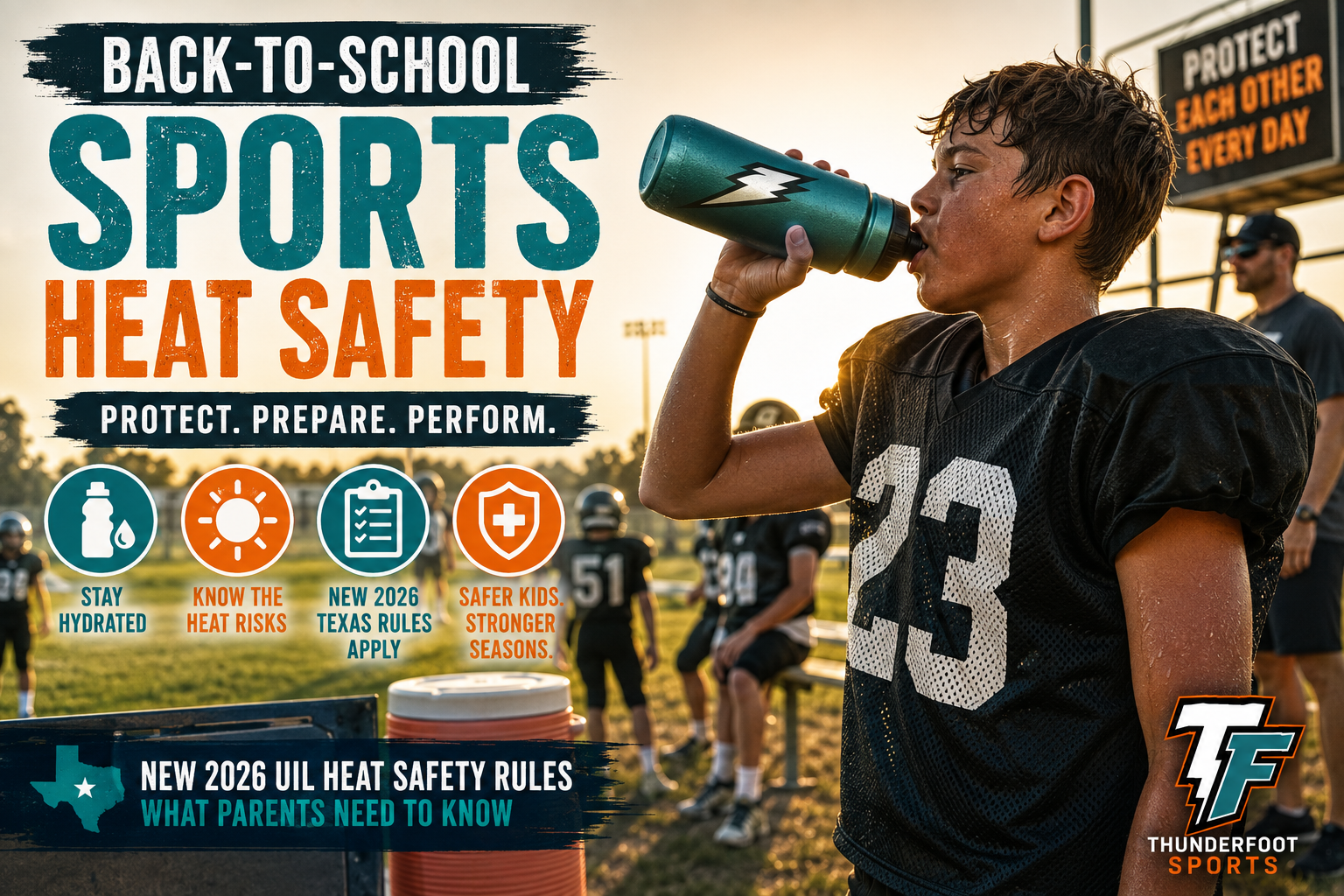
The school calendar may say fall, but the thermometer in Texas often has other ideas.
Football players return to helmets and shoulder pads. Cross-country runners begin building mileage. Soccer, tennis, volleyball conditioning, cheer and marching band practices ramp up just as afternoon temperatures remain near their summer highs.
That combination makes the start of the school year one of the most important times for parents to pay attention to heat safety.
Athletes are frequently returning from vacations, inconsistent summer workouts or mostly indoor training. Some are entering a new sport, wearing heavier equipment or practicing twice as long as they did on their own. The Centers for Disease Control and Prevention advises athletes to begin slowly, increase intensity gradually, drink more water than usual and stop activity when they feel faint or weak.
Texas has also made a major change for the 2026–2027 school year: heat protocols that were previously recommended are now mandatory for University Interscholastic League member schools.
Parents should understand what those rules require—and what they do not.
Plan the Season, Not Just the Practice
Use the Texas Gameday Finder to plan upcoming Texas sports outings, and check the Texas High School Sports Calendar for school-sports dates as schedules change through the year.

First, a clarification: Is this a new Texas law?
The biggest change taking effect this fall is technically a new statewide UIL rule, not a newly passed act of the Texas Legislature.
Beginning August 1, 2026, UIL member schools must use Wet Bulb Globe Temperature measurements to monitor conditions and modify outdoor athletic and marching-band activities. The change applies to the 2026–2027 school year and replaces the previous recommended approach with required standards.
Existing Texas law still matters. Texas Education Code Section 33.202 requires safety training for coaches, trainers, athletic sponsors and marching-band directors. The training addresses emergency planning, communication with emergency responders and recognition of potentially catastrophic injuries, including heatstroke. Schools must also conduct safety drills and provide student participants with relevant safety education.
The practical takeaway is simple:
Texas already required heat-emergency education. The new UIL rule now requires schools to measure actual heat stress and follow statewide activity standards.
What is WBGT, and why is it better than the temperature?
The temperature displayed on a phone is only part of the picture.
Wet Bulb Globe Temperature, or WBGT, accounts for temperature, humidity, wind and solar radiation. That makes it more useful for evaluating someone exercising on a sunny field than the regular heat index, which is calculated for shaded conditions.
Under the new UIL plan, schools must check WBGT within 15 minutes before outdoor practice begins and every 30 minutes during the practice or workout. Schools may use an approved onsite instrument or an approved internet-based forecasting resource.
As WBGT rises, the UIL chart can require changes involving:
- Practice length
- Work-to-rest ratios
- Hydration breaks
- Equipment worn
- Intensity of activity
- Cancellation or termination of practice
The exact thresholds vary according to the UIL heat-classification area assigned to the school. Parents do not need to memorize the chart, but they should know that “it is only 94 degrees” is no longer an adequate heat-safety assessment.
Water cannot be withheld
The new UIL plan states that coaches and directors must promote unrestricted access to water and that athletes should never be denied water. Required rest periods must involve actual rest, with unlimited hydration and no drills or other activity taking place during the break.
That is an important cultural shift for anyone who grew up hearing that water breaks made athletes soft.
They do not.
The CDC recommends drinking more water than usual during hot-weather exercise and not waiting until thirst appears. Muscle cramping may be an early warning sign of heat-related illness.
Parents should send athletes with a clearly labeled, adequately sized bottle and make sure it returns home noticeably lighter. A completely full bottle after a two-hour outdoor practice deserves a conversation.
Athletes also should not intentionally overdrink enormous amounts of plain water. Hydration needs vary by body size, sweat rate, activity and practice duration. Families with questions about fluids, electrolyte products or medical conditions should ask their pediatrician or sports-medicine provider for individualized guidance.
Schools must be ready to cool an athlete immediately
One of the most important requirements is the rapid-cooling zone.
When outdoor activity is held at or above the UIL threshold—79.7 WBGT in Class 2 or 82 WBGT in Class 3—the school must have immediate access to equipment capable of full-body cooling. That can include a cold-water immersion tub or an ice-water tarp used for tarp-assisted cooling. Shade, fans, misters and ice towels may supplement the setup, but they do not replace the ability to cool the entire body rapidly.
Each school’s emergency action plan must include procedures for recognizing and responding to a heat emergency.
For parents, that creates several reasonable preseason questions:
- Where is the rapid-cooling equipment kept?
- Is it present at the actual practice field?
- Who is responsible for taking WBGT readings?
- Who can initiate cold-water immersion?
- Is an athletic trainer onsite?
- What is the emergency plan when the team practices off campus?
- How are parents notified after a heat-related incident?
A stock tank locked inside a storage building across campus is not particularly useful when an athlete collapses beside the football field.
Football has an additional acclimatization period
Texas football teams must follow a five-day preseason acclimatization period.
During the first two days, athletes may wear only shirts, shorts and helmets, and contact is prohibited. Shoulder pads and padded girdles can be added on days three and four, but player-to-player contact remains prohibited. Day five allows limited person-to-person contact, but not full contact. Athletes who join practice late must complete their own five-day acclimatization period.
The rules also limit the length and frequency of practices and require recovery time between multiple sessions. Once school begins, state law limits extracurricular practice outside the school day to eight hours during the school week for each activity.
Parents should not privately put a child through several days of intense full-pad workouts immediately before official practice begins. Acclimatization is more than becoming mentally tough. The body needs time to become more efficient at sweating, cooling and managing workload in the heat.
The American Academy of Pediatrics recommends gradually increasing the intensity and duration of heavy activity over a period of time, scheduling demanding exercise during cooler hours when possible and providing frequent water and rest breaks.
Build a safer return before the first official practice
A safer fall season starts at home.
Begin activity gradually
A child who has spent most of July indoors should not begin August with repeated sprints in full sun.
Start with shorter, lower-intensity sessions and build duration gradually. Early workouts should focus on movement quality, conditioning and consistency—not proving toughness on day one.
Restore the sleep schedule
Back-to-school sleep changes can hit at the same time as preseason practice.
Move bedtime and wake-up time toward the school schedule before classes begin. An exhausted athlete is less likely to notice early symptoms, communicate clearly or recover well between practices.
Eat before demanding activity
Athletes need enough food to support both school and training.
A child who skips breakfast, barely eats lunch and then reports to a two-hour practice is beginning with a preventable disadvantage. Meals and snacks should include carbohydrates for activity, protein for recovery and normal dietary sources of sodium and other nutrients.
Review health concerns
Parents should notify the appropriate school medical professional about previous heat illness, fainting episodes, current sickness or medications that could affect safe participation.
A child recovering from fever, vomiting or diarrhea may begin practice already dehydrated. When there is any doubt, ask the child’s clinician whether participation should be modified.
Create permission to stop
Tell your athlete clearly:
You will never be punished at home for reporting heat symptoms or asking for water.
Young athletes sometimes hide symptoms because they fear losing their position, disappointing a coach or looking weak in front of teammates. Parents and coaches should make speaking up part of being a responsible teammate.
Know the difference between struggling and an emergency
Heat illness can progress quickly.
Possible warning signs of heat exhaustion include heavy sweating, headache, nausea, dizziness, weakness, thirst, irritability and muscle cramps. An athlete experiencing symptoms should stop activity, move into a cool area and be evaluated rather than being told to finish the drill.
Heatstroke is a medical emergency. Warning signs can include:
- Confusion
- Unusual behavior
- Slurred speech
- Loss of coordination
- Staggering
- Collapse
- Seizures
- Loss of consciousness
- Very high body temperature
An athlete with exertional heatstroke may still be sweating heavily. Dry skin is not required for heatstroke.
Call 911 and begin rapid cooling immediately. Remove excess clothing and equipment and use cold-water immersion when trained personnel and equipment are available. UIL guidance emphasizes rapid full-body cooling rather than waiting for an ambulance before beginning treatment.
Do not give fluids to an athlete who is confused, unconscious or unable to swallow safely.
Games are treated differently from practices
This is one area parents should understand clearly.
The required UIL practice limitations tied to WBGT do not formally apply to contests. Schools are still expected to monitor conditions, maintain rapid-cooling equipment when thresholds are met and make responsible modifications. UIL suggestions include later start times, additional official timeouts, longer halftimes, sideline shade, fans, misters and reduced quarter lengths for some sub-varsity contests when schools agree.
That means a game is not automatically canceled simply because practice would have been restricted under the same WBGT reading.
Parents should pay attention during middle-school and junior-varsity games where athletes may stand in direct sun before kickoff, receive fewer sideline resources or travel on a hot bus before competing.
What parents should ask the school
You do not need to interrogate the coach like opposing counsel. A few calm questions can reveal whether the program has planned appropriately:
- Which UIL WBGT classification does the school follow?
- How are readings taken and communicated?
- What changes occur when conditions move into a higher-risk category?
- Where is water located during every drill?
- Is a rapid-cooling tub or tarp available?
- Who leads the heat-emergency response?
- Does the plan travel with the team?
- How are late-arriving football players acclimatized?
- What happens when an athlete reports headache, nausea or dizziness?
- Who should a parent contact with a safety concern?
UIL says potential violations of the required protocols may be considered by the local District Executive Committee, which can apply penalties or refer serious matters to the State Executive Committee.
Start with the coach, athletic trainer or athletic director. When a serious concern is not resolved, document the issue and follow the district’s administrative process.
Final whistle
Texas athletes should be challenged.
They should learn discipline, teamwork, preparation and how to keep going when a practice becomes difficult.
But heatstroke is not a character-building exercise.
The new 2026 UIL rules give Texas schools a stronger, more consistent framework: measure WBGT, modify practices, allow unrestricted water, provide real rest and keep rapid-cooling equipment ready.
Parents still play an essential role.
Help your child return gradually. Send them fueled and hydrated. Ask how the school measures heat stress. Make sure your athlete knows that confusion, dizziness, nausea and unusual weakness are not symptoms to hide.
The goal is not merely to survive August practice.
It is to keep kids healthy enough to enjoy the entire season—because sports are better when every athlete gets home safely, and Life Is Better Outside.
Keep Exploring Youth & School Sports
Browse more Youth Sports guides, check the Texas High School Sports Calendar, or use the Texas Gameday Finder to plan what’s next.